Hair Toppers for Fine and Thinning Hair: What You Need to Know
For many women, thinning hair does not happen all at once. It often begins quietly, with a part that looks a little wider than it used to, less volume at the crown, or hair that feels flatter no matter how it is styled. These subtle changes can feel discouraging, especially when you are used to relying on your own hair to feel polished and confident.
Hair toppers can be a beautiful solution for women who are experiencing fine hair, thinning at the crown, or visible part-line thinning. Unlike a full wig, a topper is designed to work with the natural hair you still have. It adds coverage, fullness, and softness exactly where you need it most.
The challenge is that the information online can quickly become overwhelming. Social media, influencers, brand videos, and pop-up wig events can all make it feel like you need to make a fast decision. My goal is very different. At Petra Tuss Salon, I provide a private, calm, and supportive space where you can explore your options without pressure, embarrassment, or a sales-focused experience.

What Is a Hair Topper?
A hair topper is a partial hairpiece that clips into your natural hair to provide coverage where thinning is most noticeable. Most toppers are designed to cover the top of the head, crown, part line, or front hairline, depending on the size and construction of the piece.
For women with fine or thinning hair, toppers can be especially helpful because they do not require you to cover all of your natural hair. Instead, they blend with your existing hair to create the look of more fullness, better density, and a more balanced shape.
A topper may be a good fit if you are noticing:
A widening part
Thinning through the crown
Visible scalp at the top of the head
Hair that feels too fine to style with volume
Breakage or loss of fullness around the top
A desire for coverage without wearing a full wig
Toppers are not one-size-fits-all. The most natural-looking result comes from choosing the right base size, density, color, texture, and cut.
Why Shopping for Toppers Can Feel Overwhelming
If you have already started researching toppers, you have probably noticed how much information is out there. Social media can be helpful, but it can also create confusion. One influencer may recommend one type of topper, while another says something completely different. A brand may promote a certain cap construction, while a pop-up wig event may encourage you to buy something quickly before you have had time to think.
For women experiencing hair loss or thinning, this can feel emotional and exhausting.
You may be wondering:
Do I need a topper or a wig?
How much coverage do I need?
Will people be able to tell?
What if the color does not match?
What if it feels too bulky?
What if I spend money on the wrong piece?
These are valid concerns. You should not feel rushed, pressured, or embarrassed while trying to make such a personal decision.
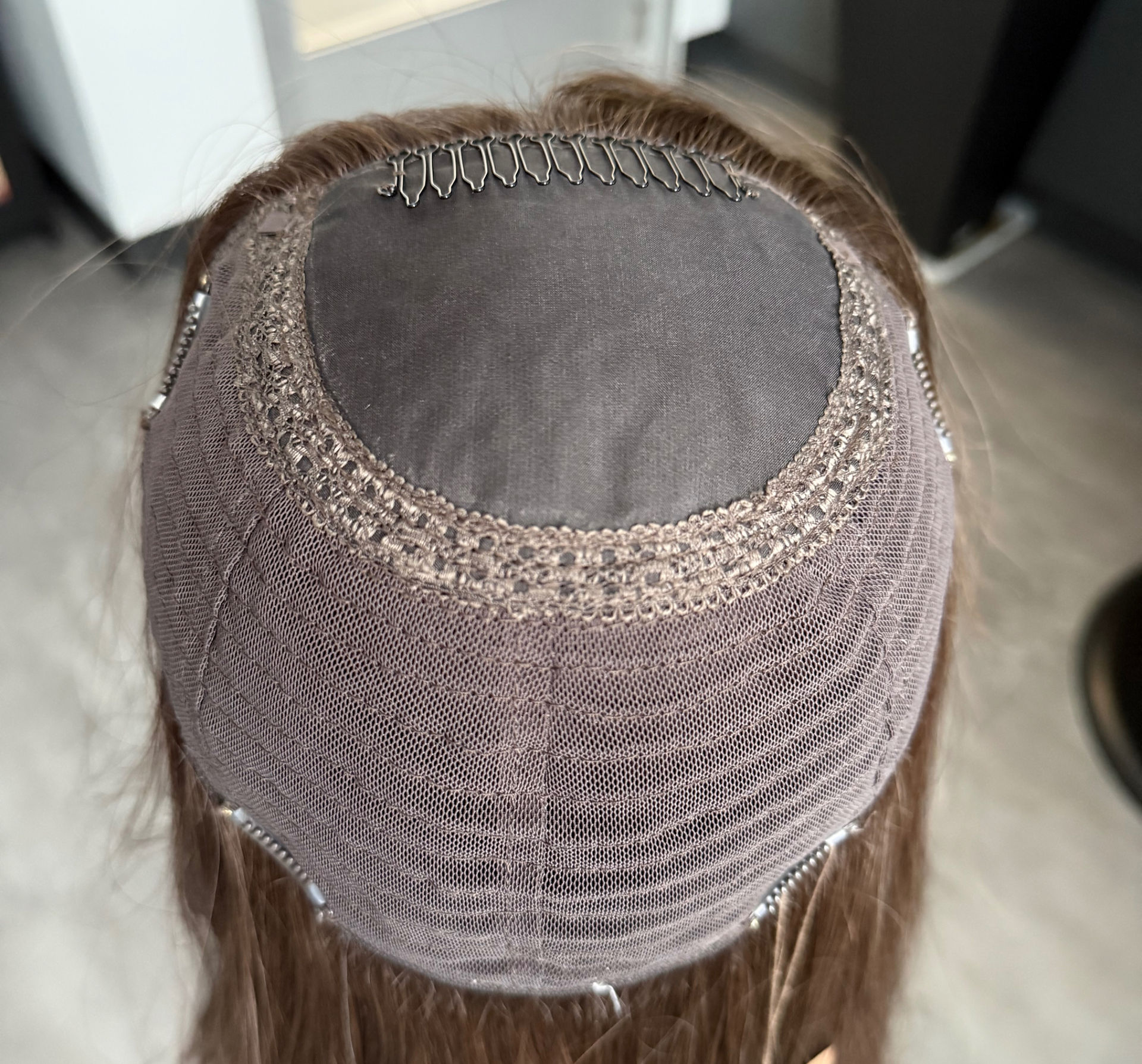
Crown Coverage: Why Base Size Matters
One of the most important parts of choosing a topper is understanding how much coverage you actually need.
If your thinning is mainly along the part line, a smaller base may be enough. Smaller toppers can add subtle fullness and help disguise scalp visibility without feeling bulky. For example, a smaller topper options for women who need targeted part-line or crown coverage.
If your thinning extends across the crown or top of the head, you may need a larger base. A larger topper gives the piece enough room to cover the full thinning area while still blending naturally into your own hair.
A good topper should extend slightly beyond the area of concern. If the base stops right at the thinning edge, it may not provide enough coverage or security. This is one reason an in-person consultation can be so helpful. Seeing the thinning pattern in person allows me to recommend a base size that feels secure, comfortable, and natural.
Part-Line Thinning vs. Crown Thinning
Part-line thinning and crown thinning are often talked about together, but they may need slightly different topper solutions.
Part-line thinning usually appears as a widening center part, side part, or visible scalp along the top where the hair naturally separates. In this case, a topper with a realistic scalp appearance, flexible parting, and low-to-medium density can create a soft, believable result.
Crown thinning often shows up farther back on the top of the head. It may look like a flat spot, reduced volume, or visible scalp when the hair is styled down. Crown coverage usually requires a topper that has enough base size and density to cover the area without looking heavy.
This is where customization matters. The right topper should not only cover the thinning area. It should also match how your hair naturally falls, where you prefer to part it, and how much fullness looks believable on you.
Density: Why More Hair Is Not Always Better
When women first begin shopping for toppers, it can be tempting to choose the fullest option available. For fine hair, that is not always the best choice.
Density refers to how much hair is built into the topper. A topper that is too dense can look disconnected from fine natural hair. It may appear too thick at the top, too heavy around the face, or difficult to blend with the hair underneath.
For many women with fine hair, a low-to-medium density topper looks the most natural. It provides the softness and coverage you need while still looking believable next to your own hair.
This is something Shani Wigs touches on in their education and product descriptions, where low-density toppers are often designed for seamless blending. Milano Wigs also offers topper options with natural density levels so the finished result feels wearable rather than overwhelming.
The goal is not to create the most dramatic change. The goal is to restore balance, softness, and confidence in a way that still feels like you.

Color Matching: More Than Choosing Blonde or Brown
Color matching is one of the biggest reasons toppers can feel confusing online. A natural-looking match is not just about choosing blonde, brunette, grey, or red. It is about depth, tone, dimension, root color, and how the topper blends with the hair you are keeping out around the sides and back.
For example, two blondes can look completely different. One may be cool and bright, while another may be warm, beige, or dimensional. Brunettes can also vary from soft neutral brown to rich chocolate, warm caramel, or cool espresso.
Human hair toppers often allow more customization than synthetic pieces. Depending on the piece, they may be toned, rooted, softened, or adjusted by a professional to create a closer blend. MHWigs, Milano Wigs, and Shani Wigs all highlight the importance of selecting quality pieces that can look natural and work with your lifestyle.
In my salon, color matching is approached with care. I look at your natural hair in person, including the tone at your roots, the brightness through your ends, and the way your hair moves. This helps create a more seamless result than guessing from a screen.
Blending With Your Natural Hair
A topper should not sit on top of your hair like a separate piece. It should blend into your haircut, texture, and overall shape.
Blending depends on several details:
The correct base size
The right density
A realistic scalp appearance
A close color match
Proper placement
A custom cut-in
Styling that connects the topper to your natural hair
For women with fine hair, blending can be especially delicate. The natural hair around the topper may be softer or less dense, so the topper needs to be chosen carefully. Too much hair can overwhelm the look. Too little coverage may not solve the concern.
This is why I do not believe in rushing the process. A topper should feel like an extension of you, not something you are trying to hide.

Why a Cut-In Service Matters
Even a beautiful human hair topper may not look fully natural straight out of the box. Most pieces need some level of customization.
A cut-in service helps blend the topper into your own haircut. This may include soft face-framing, layering, removing weight, shaping the perimeter, or adjusting how the piece falls around your face.
This step is often the difference between a topper that looks like “nice hair” and a topper that looks like your hair.
At Petra Tuss Salon, I customize wigs and toppers so they feel personal, wearable, and natural. That may include cutting, blending, styling, and helping you understand how to wear and care for your piece at home.
.
A Private, Pressure-Free Approach
At Petra Tuss Salon, my approach is intentionally calm and private. I understand that trying on alternative hair can feel vulnerable, especially if you have been silently dealing with thinning hair for a long time.
My goal is to create a safe space where you can ask questions, try pieces, learn what works, and make a decision with clarity. I do not believe every woman needs the same solution. Some women need a small topper for part-line support. Some need more crown coverage. Some may eventually feel better in a wig. Others simply need education before they are ready to decide.
There is no pressure to buy before you feel comfortable.
My role is to guide you through the process with honesty, experience, and care so you can choose a piece that supports your lifestyle, your hair goals, and your confidence.
Is a Hair Topper Right for You?
A hair topper may be a good option if you still have enough natural hair to blend around the sides and back, but want more coverage through the top, crown, or part line. It can be a wonderful choice for women with fine hair who want a natural-looking solution without committing to a full wig.
The right topper should feel comfortable, secure, and realistic. It should match your hair color, complement your density, and blend into your style with a professional cut-in.
Most importantly, it should help you feel more like yourself.
Final Thoughts
Hair toppers can be a beautiful, confidence-restoring option for women with fine and thinning hair. When chosen well, they can soften the appearance of a widening part, add fullness at the crown, and create the look of healthier, fuller hair without covering everything.
The key is choosing thoughtfully. Base size, density, color, construction, and customization all matter.
If you are feeling overwhelmed by social media, influencer advice, online shopping, or high-pressure wig events, you do not have to figure this out alone. A private consultation can help you understand your options in a calm, supportive setting.
At Petra Tuss Salon in Bothell, I offer personalized guidance for women exploring wigs and toppers throughout the greater Seattle area. Together, we can look at your hair, your lifestyle, your coverage needs, and the type of result that will feel most natural for you.
When you are ready, I invite you to schedule a private wig or topper consultation. My goal is to help you feel informed, comfortable, and confident, without pressure.


Comments